SERVICE
Artificial Intelligence / Data Science
Sync AI to Business
PERFORMANCE
Artificial intelligence and data science
Sync AI to Business
Get in touch with us!
Jörg Frank looks forward to hearing from you.
Unleash the untapped potential of your data
Benefit from the paradigm shift in IT and the availability of open source data sets and models. Scale the added value of your data via the cloud. Let cognitive services work for you and support you in making data-driven decisions. Enable your organization to acquire future-relevant AI skills.
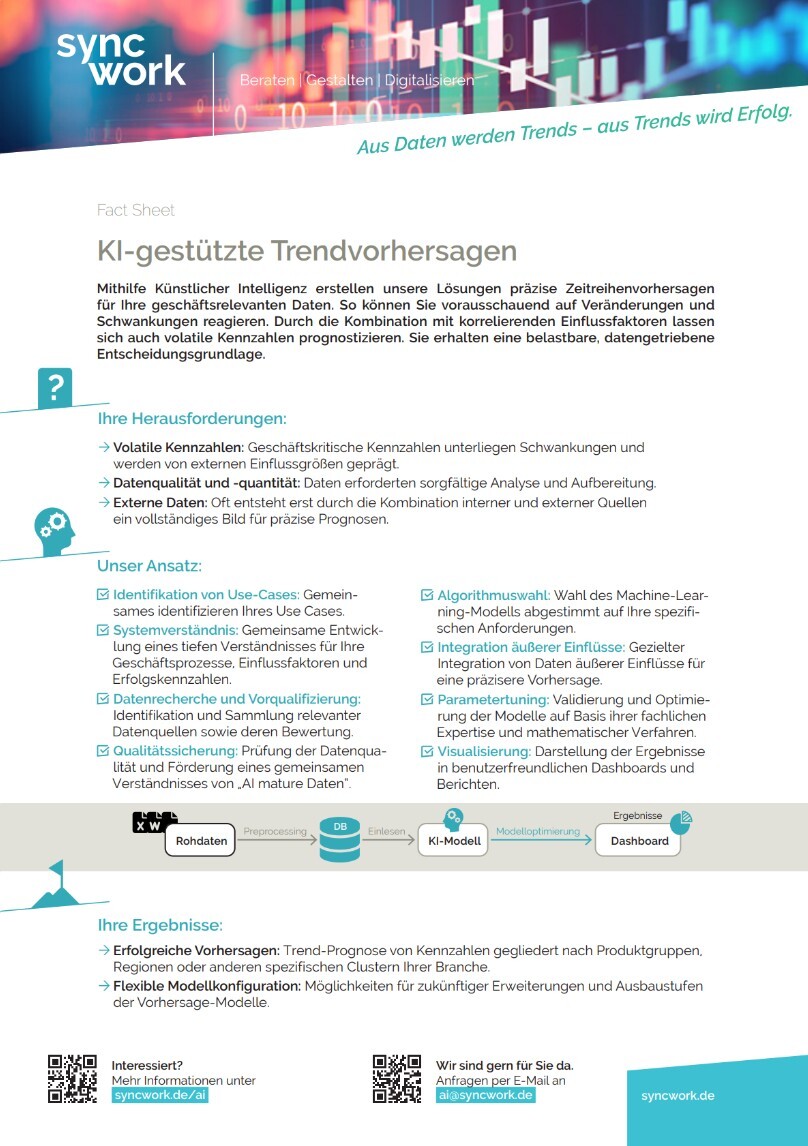
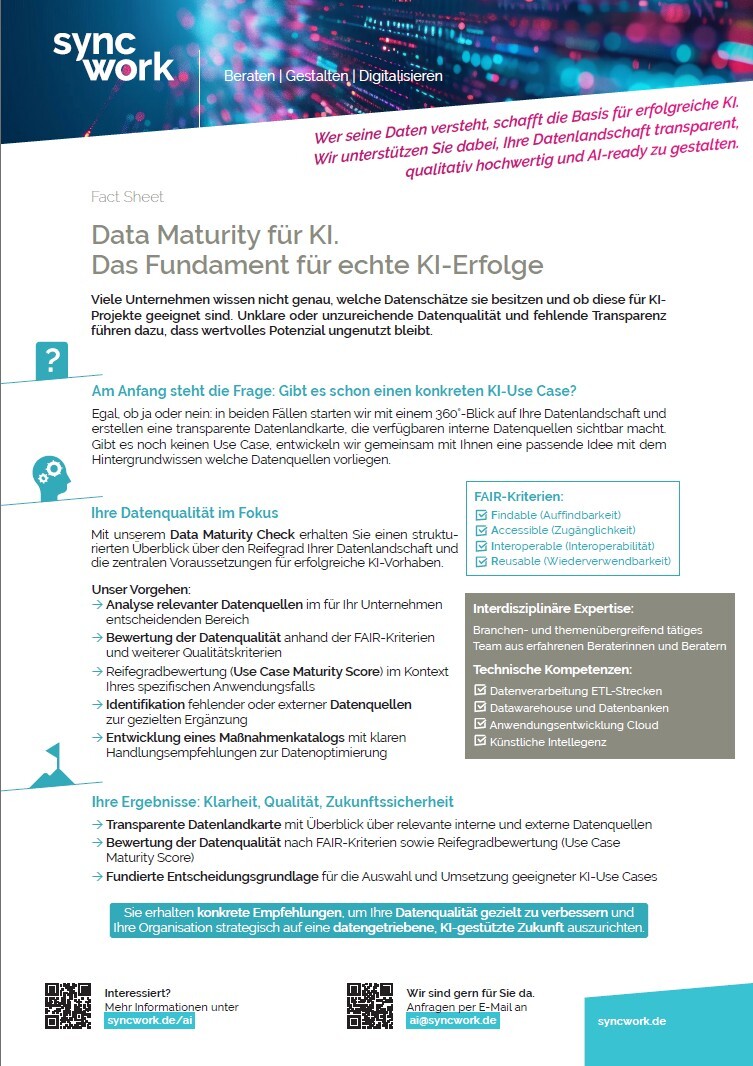
Take a look at data science and artificial intelligence with us and learn about the possible applications and benefits. Our holistic consulting approach offers a process tailored to your company - from feasibility analysis and your first prototype to the full implementation of your data science project.
Syncwork has 20 years of expertise in data warehousing, which has laid the foundation for data science and AI development solutions. Since 2017, we have been developing data science projects for our customers, from medium-sized companies to DAX-listed corporations.

Your advantages
Leverage the value of your data with a first-class AI solution.
Development of future-critical competitive advantages
Ensuring reliable standards in a legally compliant and qualified manner.
What we offer
From AI strategy and implementation to responsible, scalable solutions
Assessments of AI feasibility
We create decision-making certainty for AI: with confidential data analysis, realistic business value scenarios and a concrete implementation plan.
AI prototype development
From the idea to the AI prototype: We deliver executable dashboards or web apps with open source code - securely implemented in the Syncwork Lab (Azure).
Minimal Viable Product (MVP)
We bring a productive solution live quickly and create the basis for further development with a clear backlog.
Syncwork AI Lab
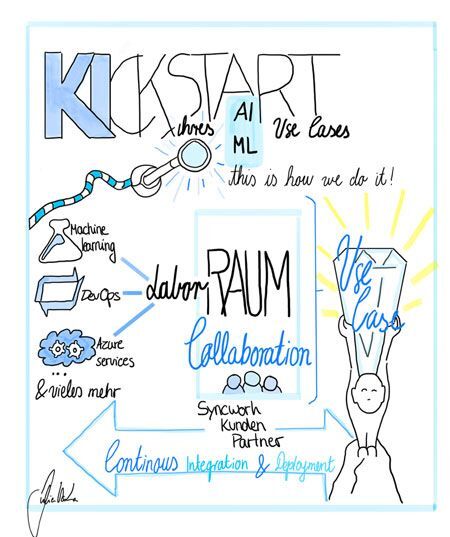
Use our Syncwork infrastructure as a development environment to set up your first prototype. Resources are set up flexibly in the cloud and enable you to kick-start your developments. Afterwards, nothing stands in the way of a migration to your on-premise or cloud infrastructure.
The main pillars of our laboratory infrastructure consist of:
- Azure Cloud
- Azure DevOps
- Azure Cognitive Services
- Machine Learning Studio
- Azure Cloud
- Azure DevOps
- Azure Cognitive Services
- Machine Learning Studio
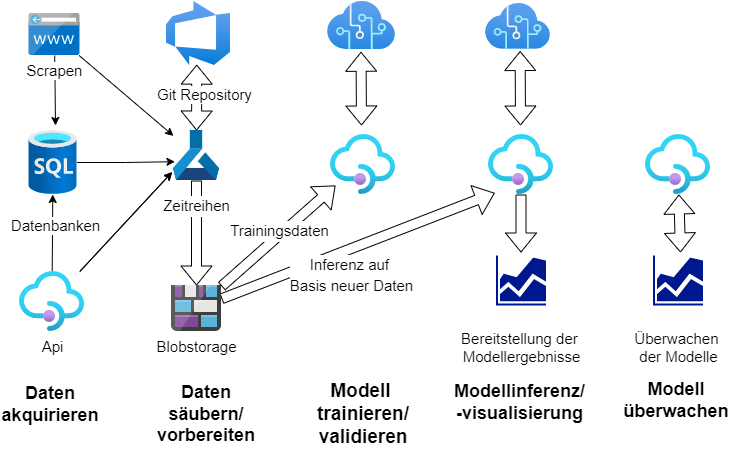
Reference architecture: Use of a cognitive service
Reference architecture for the development of a cloud-based solution for the connection of external public databases and the analysis of multivariate time series by a cognitive service.
Use case: Inference skill matrix with tender documents
Tender documents are automatically analyzed using a cognitive service. First, the required skills are extracted and then compared with those in a skills database. The result shows the extent to which the required skills are covered by the matched profiles.
Technologies used: The implementation was realized as a Jupyter Notebook in Python and uses various libraries and services, including Pandas, Numpy, NLTK, PyMuPDF, transfer learning, Azure AI Text Analytics.

The laboratory infrastructure and its components can be used as a reference architecture for subsequent further development. Within our labs, we are able to map every process step of a data science project.
Jörg Frank | Management Consultant / Board of Directors
About Jörg Frank
Natural Language Processing (NLP) explained using our own example
NLP gives structure to unstructured data by analyzing text.
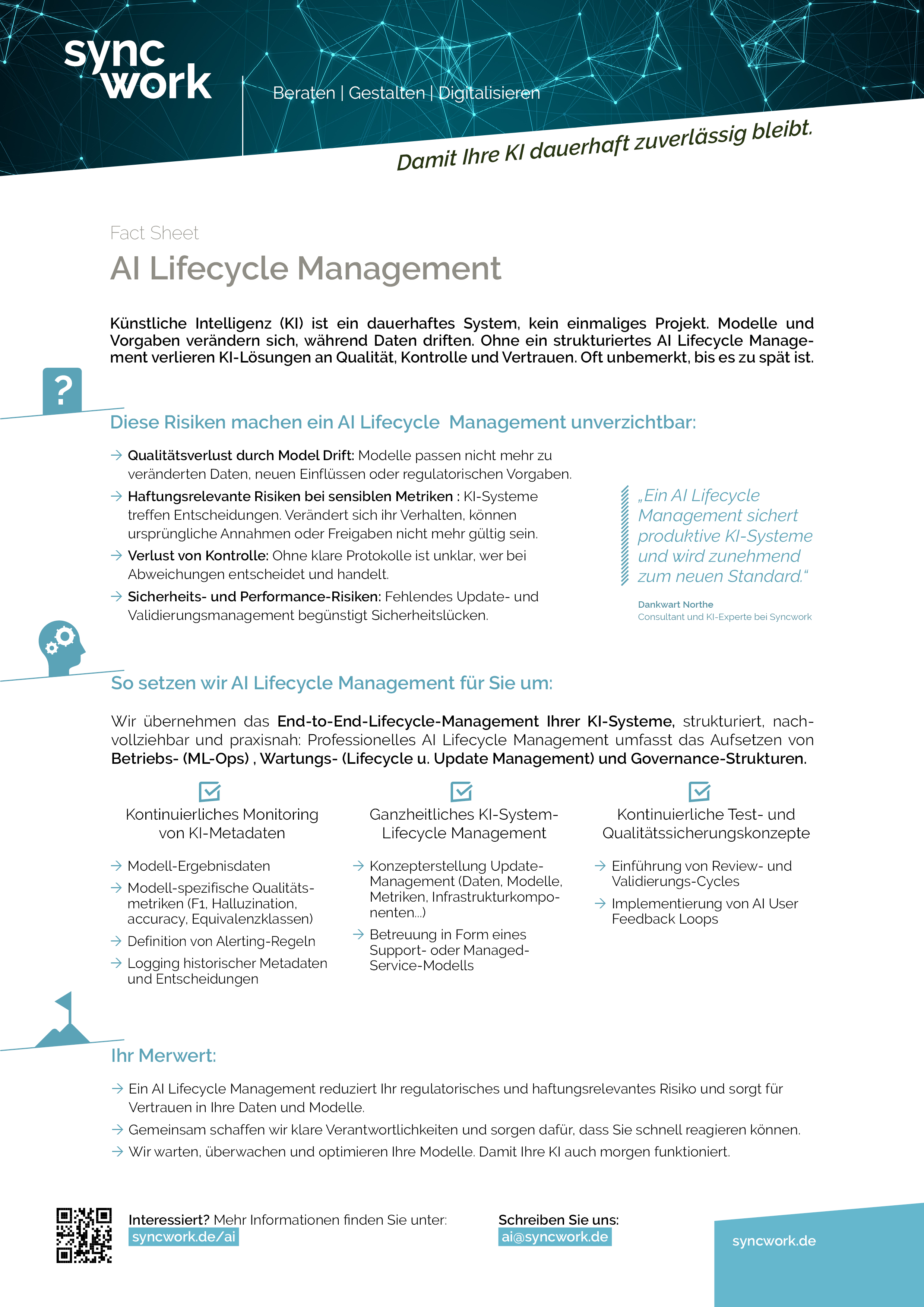
AI validation
Immerse yourself in the world of AI validation! We ensure that you exploit the full potential of AI and meet the highest quality standards while complying with legal regulations.

Our references
Selected examples of our NLP projects
Natural Language Processing (NLP) in the field of drug safety
Analysis of social media posts for an international pharmaceutical company to determine the side effects of drugs using natural language processing. This includes recognizing the significance of side effect reports and classifying them into positive and negative reports.
AI validation: detection of side effects
With the help of AI, side effects and product defects are to be recognized and marked from texts in specialist literature and colloquial language. The service can be used by various systems via generic APIs. The model was trained by manually classifying and annotating defined categories and its quality was determined in the validation cycle. The process is validated from the receipt of the text to the transmission of the result.
Automation Document Intelligence (ADI)
ADI (Automated Document Intelligence) is used to automatically read, analyze and classify documents for an international life science group and make them available in the document management system.
Online predictive maintenance
Online predictive maintenance comprises the implementation of predictive maintenance of an exhaust gas purification system for the production facilities of an international life science group based on a cloud infrastructure.
Fraud detection in clinical trials
To conduct pharmaceutical studies for an international pharmaceutical group, study data from various source systems was combined and a comprehensive reporting system was set up. Model governance and integration of fraud detection models into the DWH, with the aim of detecting and reporting cases of fraud within clinical trials at an early stage.
Proof of concept: Risk management system - P-i-T PD modeling
This P-i-T (point-in-time) model includes the determination and presentation of risk parameters, such as the probability of default, taking into account and mapping economic and structural fluctuations. Economic aspects are incorporated into the model using macroeconomic key figures.
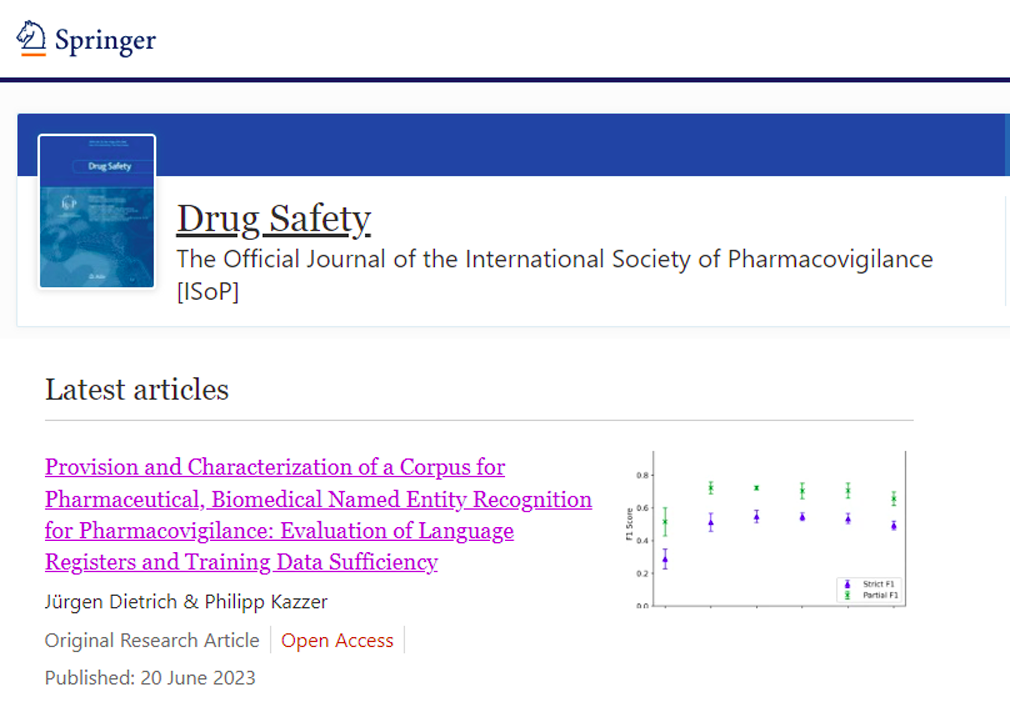
Abstract on important aspects of GxP-relevant validation of machine learning models
A successful and long-standing collaboration between Bayer AG and Syncwork culminates in this publication by Jürgen Dietrich of Bayer and Dr. Philipp Kazzer. The work examines important aspects of GxP-relevant validation of machine learning models.