



Services
Databricks@Syncwork
Collaborative, scalable data and AI on a unified platform
Unlock the untapped potential of your data
Companies face the challenge of exponentially growing data volumes and, in most cases, fragmented data landscapes with a lack of interoperability. These data silos hinder innovation; ERP data often remains unused; and machine learning or artificial intelligence use cases cannot be implemented.
Databricks addresses precisely these issues according to the Gartner Magic Quadrant™ for Data Science and Machine Learning Platforms, it is once again the market leader in the AI and data analytics space. Databricks is based on the Lakehouse architecture and is an open-source, cloud-vendor-agnostic platform (without vendor lock-ins) where data engineers, data scientists, and data analysts can collaborate within a single system.
Key Features
Lakehouse architecture
This architecture combines the best of data lakes and data warehouses and is based on open standards and the widely used open-source projects Apache Spark (data processing framework) and Delta Lakes.
Scalability
Databricks offers excellent scalability (optimizing storage and performance) with the goal of achieving a low total cost of ownership while delivering high performance for AI.
Unity Catalog
Various skill sets, such as data engineers and data analysts, work together using SQL or Python. Unity Catalog is the only unified, open governance solution for data and AI, and it stores (un)structured data, ML models, notebooks, and dashboards.
Data streaming / time travel
Databricks makes it possible to perform data streaming (ETL processes) and time travel (workflows, ML) on massive amounts of data and track changes using a change data feed.
Web applications
With Databricks Apps, you can create small web applications very quickly and easily with just a few clicks.
Integration
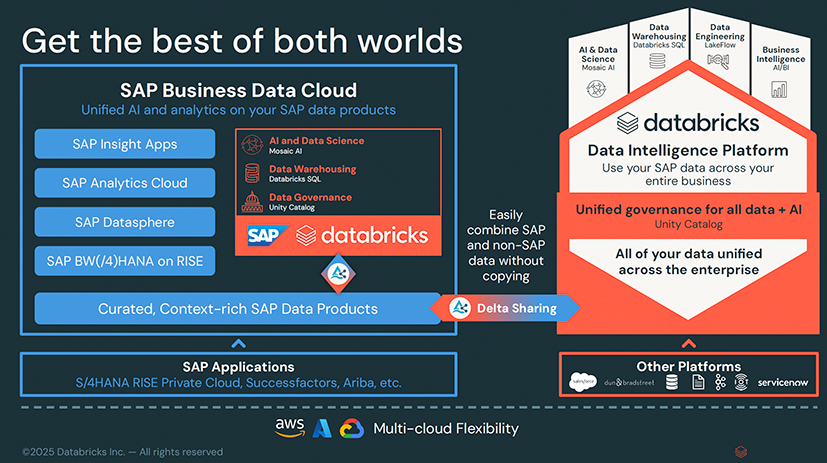
Seamless integration with the SAP Business Data Cloud (SAP BDC) starting in Q3 2025
SAP and Databricks
The best of both worlds?
Databricks’ world-class data engineering capabilities to create a groundbreaking solution that helps organizations do more with their data than ever before. With SAP as the backbone of enterprise operations and Databricks as the industry leader in AI and analytics, the fusion of these two ecosystems enables customers to break down data silos, drive real-time insights, and accelerate innovation.
Christian Klein | CEO, SAP AG
SAP customers benefit from simplified data integration, improved analytics, and the ability to develop innovative AI applications based on a consistent and trustworthy data foundation. Starting in Q3 2025, Databricks can be integrated into the SAP Business Data Cloud (SAP BDC) through the following three scenarios:
1. SAP Databricks as a new application in the SAP Business Data Cloud
- Particularly useful when workloads primarily involve SAP data
- Easy integration of ML and GenAI capabilities into the SAP environment
- Non-SAP data can be integrated via Delta Sharing
- However, it does not offer the full feature set of “Native” Databricks
3. SAP Databricks and “Native” Databricks coexist, meaning you “get the best of both worlds”
- This makes sense when different organizational units are working on different priorities
- SAP Databricks: optimal integration into the SAP environment (workloads with primary SAP data)
- “Native” Databricks: full feature set (workloads with large volumes of data)
RAG Chatbot Project Example
Built with Databricks
-
What is RAG?
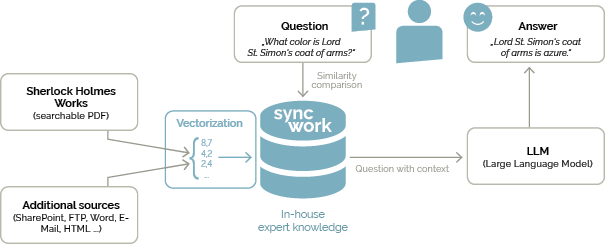
RAG (Retrieval-Augmented Generation) combines information retrieval with AI-powered text generation. The system performs targeted searches of your knowledge base and generates well-founded, up-to-date answers based on your internal data.

-
Skills
- Targeted Information Retrieval: Searches exclusively internal data sources and presents information in an understandable way
- Context-aware responses: Dynamic responses based on corporate knowledge, powered by RAG technology
- Proven LLM integration: Utilizes established language models without the need for in-house model development
- Customizable system parameters: Fine-tuning of response length, level of detail, and subject-matter accuracy
- Flexible data integration: Combines documents from various sources into a unified knowledge base
-
Technical approach
Internal documents (PDFs, Word documents, web pages, SharePoint) are automatically processed and transferred to a vector database. When users submit queries, a semantic comparison is performed to identify relevant content. This content, along with the original question as context, is passed to a language model that generates precise, context-aware answers.
-
Our services
- Benefits of using files in different formats for the knowledge base
- Optimizing similarity analysis
- Adaptive prompt optimization for precise answers
- Selection of LLMs
- Parameter tuning
- Validation/evaluation
- Context-Aware Conversations with Recall functionality
- Implementation on various platforms: Azure ML, Databricks, Amazon Bedrock
A successful partnership
Syncwork and Databricks are shaping the digital future
As a strategic partner of Databricks, Syncwork supports companies across various industries in modernizing their data platforms. In the retail sector, Syncwork helped EDEKA migrate from a complex Hadoop system to a scalable cloud solution based on Azure and Databricks - for greater efficiency, flexibility, and future-proofing.

In the healthcare sector, we continued to develop the ALYCE clinical data platform in collaboration with Bayer. A particular highlight was the presentation of ALYCE at the Databricks Data+AI Summit 2024 in San Francisco, where Bayer showcased the platform’s innovative capabilities to an international audience of experts. These projects impressively demonstrate how close collaboration with Databricks leads to sustainable data solutions - from retail to healthcare.